|
|

Slide Rule Manuals : The Good, the Bad and the Incomprehensible
Walter Shawlee 2
Over the years, I have had a chance to see manuals for slide rules from literally every corner of the world. Some were informative; some were confusing; some were just frightening by being completely non-existent. Replacing all the lost documentation out there and answering the endless questions from beginners and aficionados alike was really the motivation behind the creation of the Oughtred Society Slide Rule Reference Manual. I think I can honestly give it top marks as the best single reference money can purchase when it comes to a thorough and useful reference for almost any slide rule. It is also the best and most richly illustrated example available, and quite cheap, at under US$40. If it just had a few more setting illustrations, and more application examples, it would be perfect.
A good manual should assume nothing about the user other than their interest to understand a slide rule, and should be comprehensive enough to answer fundamental questions about the concepts, parts, operation and useful application of the rule. If it falls down in any area, it becomes less desirable as a real reference, and useful only as a highly rule specific starting point. This naturally begs the question, “Who really did a good job with their manuals?”
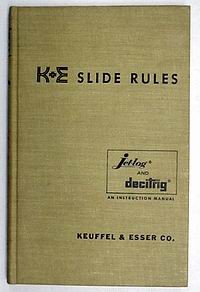
My top picks have to be K+E, especially their final two hardbound manuals (Jetlog/Decitrig and Deci-Lon), and Faber-Castell for all their documentation, right down to the folded sheets for the lowliest rules. In both cases, information is presented clearly, in a logical and intelligent order, and very well illustrated for all kinds of setting examples. Pickett comes in just behind them, and the single folded sheet Pickett produced for their simple Mannheim rules remains the best simple set of condensed instructions I have seen yet; we add it to all our Slide Rule Universe shipments when the rule has no attached manual.
I find the bound Post Versalog manual a bit disappointing, and while useful for any Versalog owner, it does not have the depth and illustrations that K+E, Faber-Castell and Pickett have. Hemmi manuals are generally also weak and have just enough content and illustration to use and set the scales in the most basic sense, and nothing further. They are helpful for specific rules, but are not good books in the reference sense. Some manuals, like the Hemmi 266 and 257 are not nearly adequate enough for the complexity of the rule.
A rare but delightful book is F-C’s 2/83N bound manual; it is quite extraordinary, and I have seen it in both English and German. The same skill and talent that generated the rule were also put into the book, and I recommend it to anyone that would like a good companion to their 2/83N or 62/83N rule. It goes further than the already excellent soft manual that comes with the rules, but is not easy to locate in North America. If somebody out there has some, I’d love to hear about them!
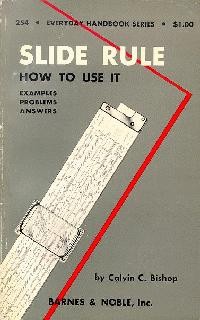
Independent books that are also very worthwhile for better slide rule knowledge are Slide Rule Simplified by C.O. Harris, and Slide Rule and How to Use It by Calvin C. Bishop, which are not expensive. One unusual book that can be used effectively to teach someone with no access to any outside instruction at all is the Tutor-Text The Slide Rule by Saffold and Smalley, although this book is hard to locate and remains fairly costly.
What book does the best job explaining how a slide rule works (and also has the world’s best explanation of logarithms)? No question, it is Isaac Asimov’s An Easy Introduction to the Slide Rule, not really a good slide rule manual, it is nonetheless the definitive book on how and why it works and is beautifully written. I feel my IQ rise every time I even pick up this book. Most copies in existence today are ex-library copies, but it also came out as a pocketbook.
Who gets the nod for the cleverest manual concepts? It has to be Pickett, who put their manuals right on the backs of some rules, like the N902T, or who provided laminated instruction cards to go right in the case with their high end radio propagation C18 rules for Collins. Most European rules also get an extra nod for being self-documenting right on the rule itself, which often made a manual less necessary for any level of use.
|

|
Slide Rule Loan Program
Mike Konshak
If you are an educator, or know an educator, wishing to give your students a hands-on experience with actual slide rules, Mike Konshak’s International Slide Rule Museum will supply quantities of up to 25 used slide rules for temporary use, free of charge, courtesy of several collectors.
Requests on school letterheads must be received in order for the slide rules to be shipped. The school will be responsible for postage and safe return of the slide rules in the time period requested.
Contact Mike Konshak : Evenings: 303-673-9853, Days: 303-272-4175, Cell: 303-921-8709, or email: curator “at” sliderulemuseum.com
If you are a collector who wishes to participate in this program by furnishing slide rules for loan, please let us know. We are looking for more international contacts. We currently have slide rules in the USA and Australia available for loan.
|


|
Slide Rule Calculation Exercise
Gary Flom
Slide rule problem :
Draw rectangle ABCD, points labelled clockwise.
AB = DC .
AD = BC .
AB > AD .
ABCD has an area of 50 sq. units .
Draw two semicircular arcs, both going outside of ABCD,
one from A to B, and the other from B to C .
The ratio of the areas of the semicircular regions is 12 to 1 .
What is the length of diagonal AC ?
|

|
Slide Rule Tips, Tricks, Shortcuts and Clever Methods
Ted Hume
Solve :
If 6 men can do a job in 4 days, how long will it take 9 men to do it?
This is an inverse proportion problem and is written thus :
6 = 9
(1/4) (1/x)
A direct solution can be obtained on your slide rule by reversing the slide. Remove it and switch ends, with the same side facing you. Your slide is now upside down.
Cursor to 4 on D
Slide to 6 on C at cursor
Cursor to 9 on C
Answer : 2.67 days on D at cursor
|

|
|
|
|
