|
|

The Slide Rule in a Mural
Mortimer Hans, Great Neck, New York
Off all the places one might think of that might depict a slide rule, surely a 235 foot wide mural would not come to mind. If one were to look up at the rotunda in the Marine Air Terminal at La Guardia Airport in New York City, there among the panels depicting the history of flight, is one showing a group of four men at a Pan American Airways ground location communicating with a Boeing 314 Flying Boat by radio and plotting the aircraft’s track across the Atlantic Ocean with the aid of what appears to be a circular slide rule.
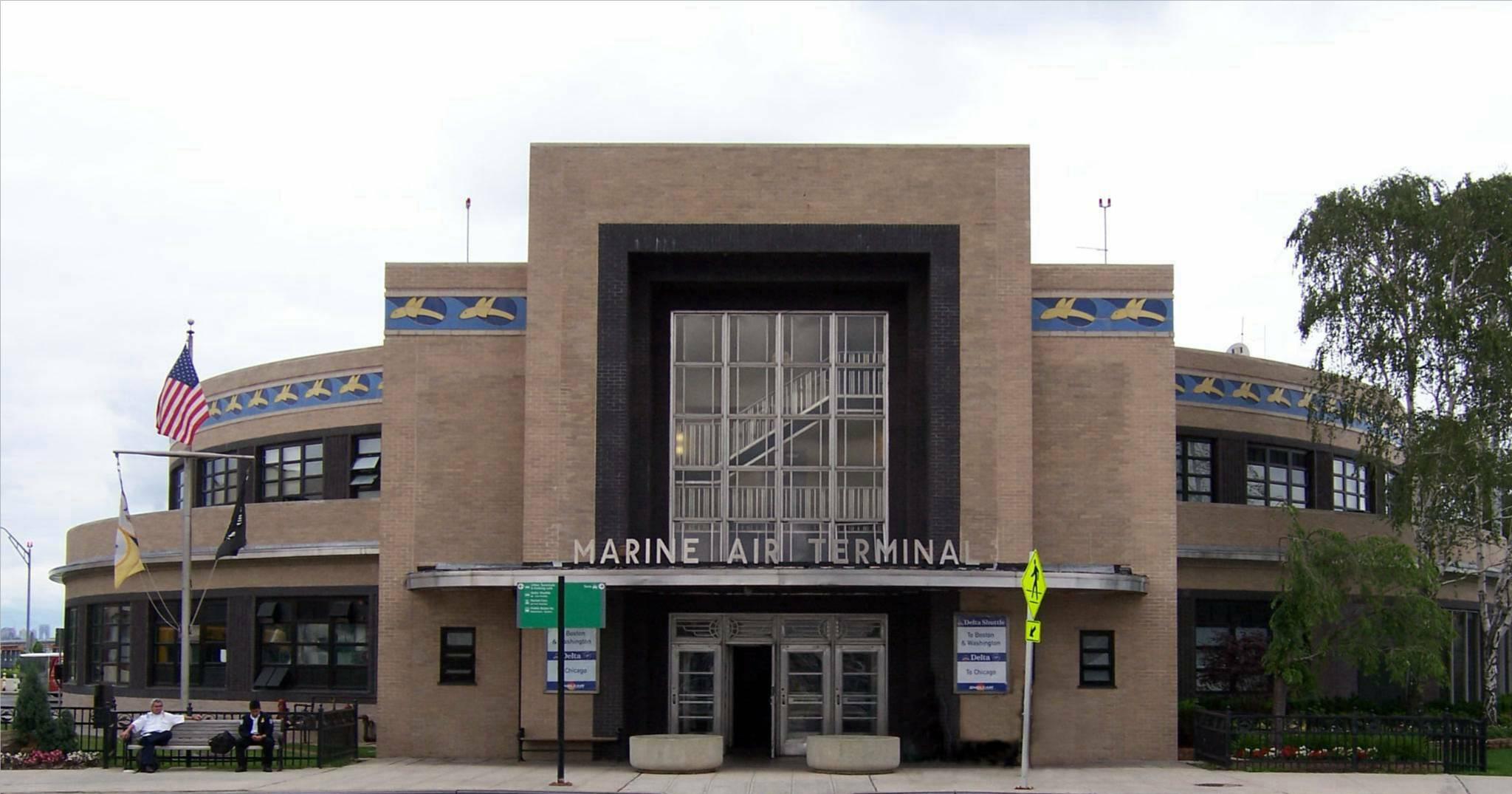
How did a slide rule come to be depicted in a mural? The story begins in the early 1930’s when the closest commercial airport to Manhattan was in Newark, New Jersey. New York City’s mayor at that time, Fiorello LaGuardia, was able to secure Works Project Administration (WPA) funding for the construction of a new airport closer to Manhattan on the Borough of Queens waterfront. The airport included a separate waterside terminal and a hangar for the giant, four-engine flying boats that Pan American was going to use in its new regularly scheduled transatlantic service. The Boeing 314 flying boats, known as the Yankee Clippers (Figure 1) had sleeping berths and a dining room, and could accommodate 40 overnight passengers with a crew of 11. The first clipper flight took place on March 31, 1940 and ended a year later with our entry into World War II. The waterside terminal which still retains its original name, the Marine Air Terminal, was given a round (for that time a modern) shape by Delano & Aldrich, the architectural design firm. The building still retains its original shape (Figure 2). It is now used by Delta Airlines for its shuttle service to Boston & Washington, DC.
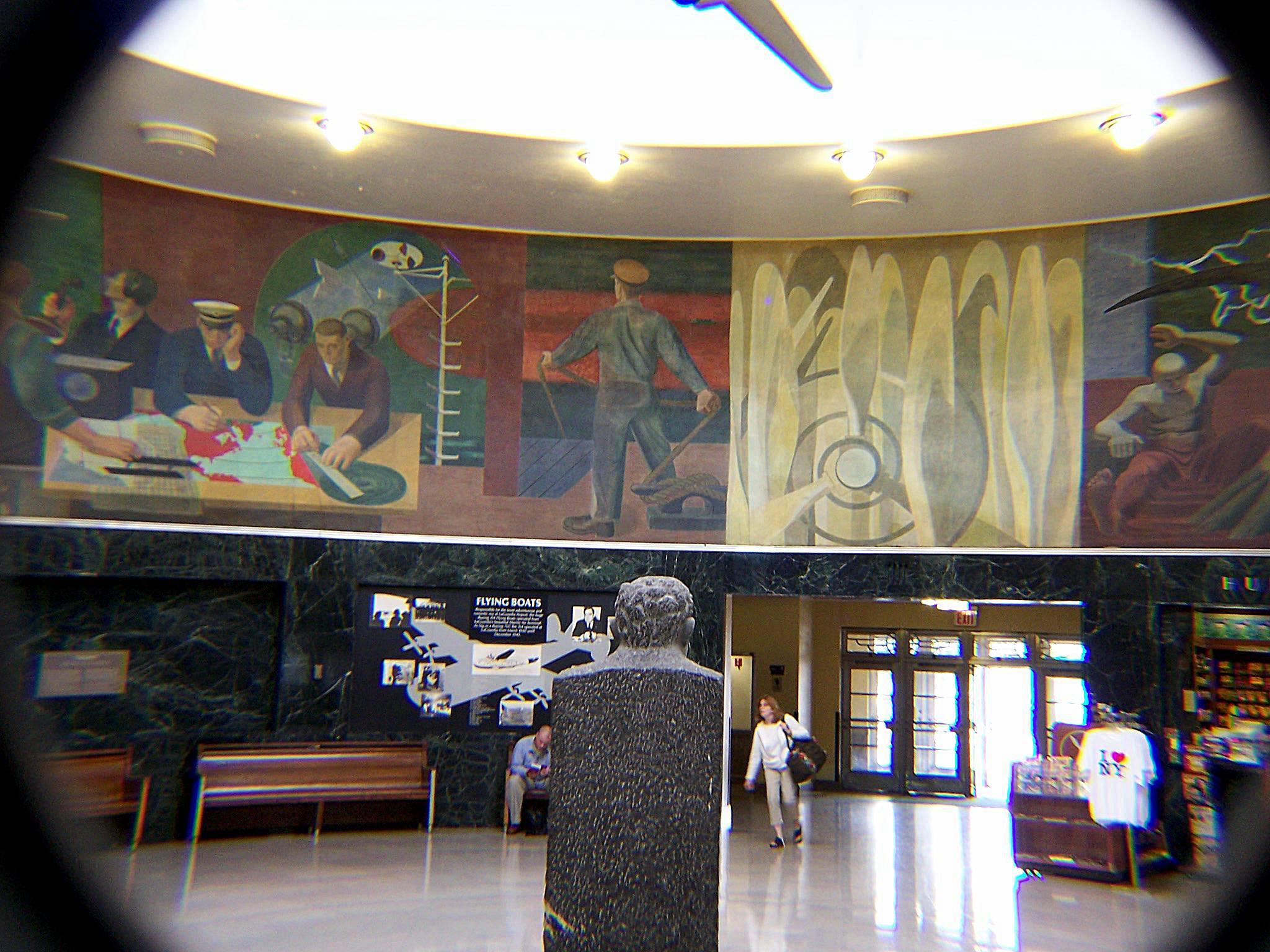
During the Roosevelt era, WPA projects were enhanced with works of art funded by the Federal Arts Program. James Brooks, an American muralist and abstract painter was commissioned in 1939 to create a mural for the Marine Air Terminal rotunda (Figure 3). The mural, “Flight,” which he completed in 1942 illustrates both man’s impulse to fly and the history of flight; with a combination of realistic and abstract images of the wax-winged soarers, Daedalus and Icarus; the flying machines of Leonardo da Vinci and the Wright Brothers; a toga-clad sky gazer and the first Pan American Clipper flight across the Atlantic among others.
As you look at the third panel to the left of the terminal in Figure 3, you see the artist’s portrayal of the four men tracking the first clipper flight from the Marine Air Terminal to Lisbon, Spain and the circular slide rule on the lower right of the table. Next to it is probably a scale used to convert distances. (The cursor is missing, but could the model for the scale have been a linear slide rule?) Like the scale and the radio loudspeaker (there’s no visible transmitter or receiver), the artist appears to have used the circular slide rule as a design element in the panel without regard to its realistic use.
But what about the circular slide rule? The mural was painted from 1939 to 1942. A reasonable guess might be that the artist had first made a sketch or an outline of the mural on the rotunda in 1939. Well, which circular slide rules were in use in 1939 that might have been used as a model? Most probably it was a Dalton or even perhaps an earlier course and distance graphical computer. Clearly the image reflects the muralist’s approach to art, his combination of realism with abstraction, which leaves us guessing as to what the original object might have been. Perhaps Dalton’s original compact-sized aircraft Time-Speed-Distance Model B Computer or the subsequent Mark VII that combined a graphical calculation of the wind triangle on the reverse side? Or perhaps the Mark VIII Aircraft Navigational Computer. Or perhaps, not a slide rule at all? James Brooks died in 1992, so we can’t ask him.
The answer will probably remain a mystery. Nevertheless, which computer do you think might have served as the model in the mural? Perhaps you can discern something in the image that points to a specific computer. If you think it does or perhaps you know, or you’d like to take a guess, send an e-mail identifying the computer model with a brief explanation of why to the Bulletin’s editor and he’ll include it in the next issue.

Fig. 4
|

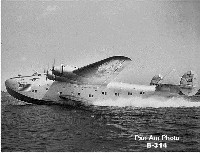
Fig. 1
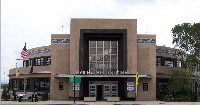
Fig. 2
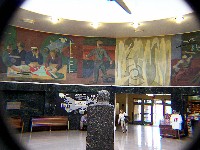
Fig. 3
|
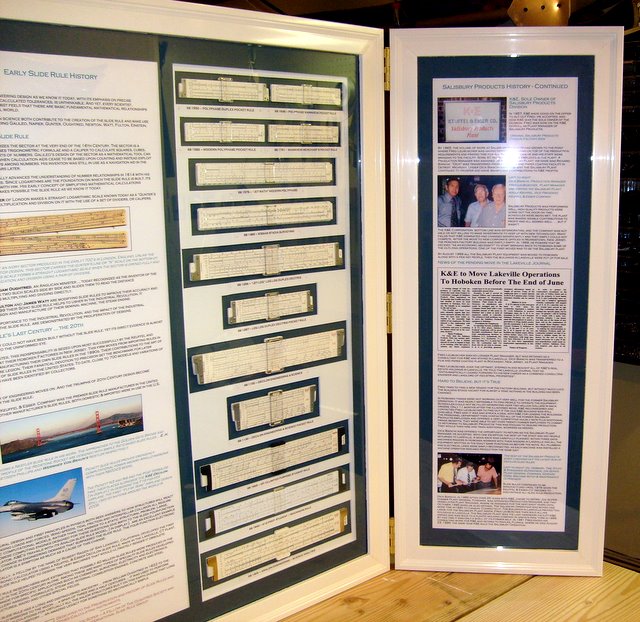
K+E and A Slide Rule Display
The Editors, Sea of Tranquility
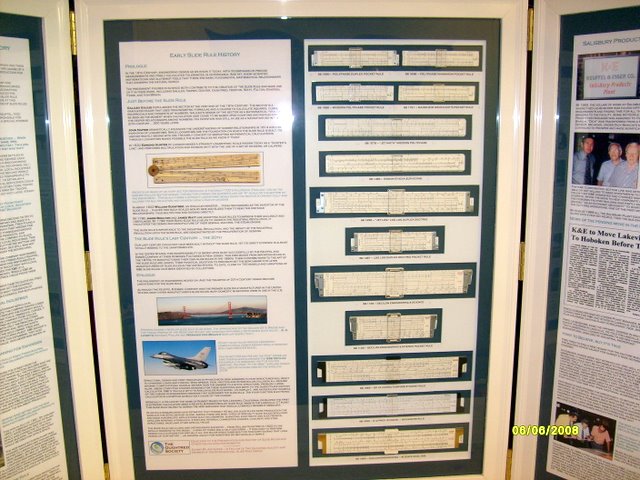
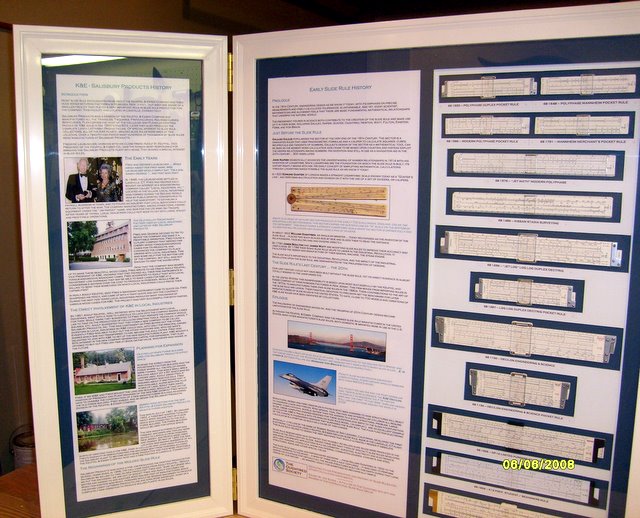
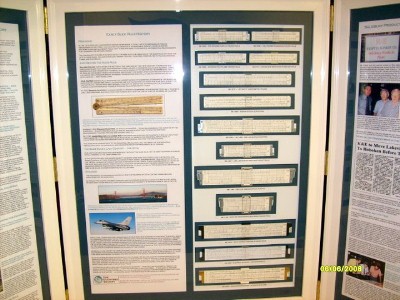
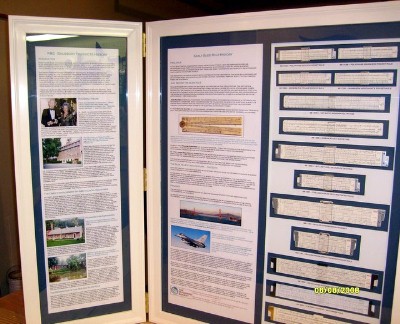
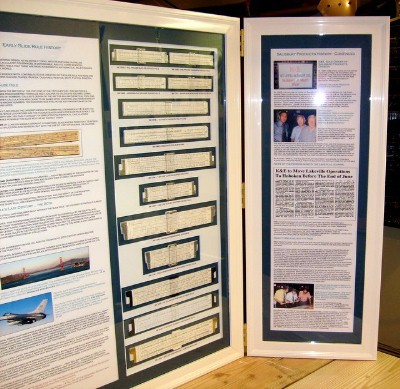
Joe Soper, the former plant manager for K+E's Salisbury facility, has created a display for the Salisbury Historical Society, showing the history of the plant, as well as a history of slide rules. Under the glass is included all of the most important slide rules that were produced in the Lakeville Plant.
|

|
Slide Rule Tips, Tricks, Shortcuts and Clever Methods
Gary Flom, Stockbridge, Georgia
Dig out one of your SRs with R1 and R2 type scales
You can find the area of a circle of radius r using only the cursor.
Set the hairline to the radius of the circle on scale R1 or R2 as appropriate.
The area of the circle can immediately be read at the hairline on scale DF.
|

|
Slide Rule Loan Program
Mike Konshak, Louisville, Colorado
If you are an educator, or know an educator, wishing to give your students a hands-on experience with actual slide rules, Mike Konshak, curator of the on-line International Slide Rule Museum will supply quantities of up to 25 matching slide rules for temporary use, free of charge, courtesy of several collectors.
Requests on school letterheads must be received in order for the slide rules to be shipped. The school will be responsible for return postage and safe return of the slide rules in the time period requested.
Contact Mike Konshak : Evenings: 303-673-9853, Days: 303-272-4175, Cell: 303-921-8709, or email: curator “at” sliderulemuseum.com
If you are a collector who wishes to participate in this program by furnishing slide rules for loan, please let us know. We are looking for more international contacts. We currently have slide rules in the USA and Australia available for loan.
|


Slide Rule Math and Rocket Course
|
Slide Rule Problems
Gary Flom, Stockbridge, Georgia
Draw a parallelogram.
One diagonal is 5.8 units.
The other diagonal is 8.6 units.
Two of the opposite sides are 5 units.
What is the length of the other two sides ?
|
|
|
|
|